
Source: Hainan Tropical Ocean University, College of Food Science — "Canghai Zhense" project (National-level Innovation & Entrepreneurship Project, initiated July 2026), and the publicly disclosed invention patent CN122188811A, titled "A High-Temperature-Resistant Red Pigment-Producing Talaromyces Strain DSF149 and Its Application" (filed May 13, 2026; published June 12, 2026; strain Talaromyces sp. DSF149, deposited under CCTCC No. M 20232230).
🪼Where Did the Strain Come From? Why "2,595m Deep Sea"?
The team screened a Talaromyces strain (formerly referred to as Penicillium-affiliated in Chinese literature), designated DSF149, from deep-sea sediments collected at 2,595 meters in the South China Sea.
- The deep-sea environment — high pressure, low temperature, oligotrophic — pushes secondary metabolism toward defensive, stable molecular skeletons. This evolutionary pressure is the underlying reason for the pigment's heat and pH tolerance.
- Terrestrial Talaromyces species (e.g., T. amestolkiae, T. atroroseus) also produce red pigments, but the deep-sea isolate's retention rate after 121°C autoclaving (>60%) is the standout metric claimed by the team. Most terrestrial strains in the literature are only tested up to 80°C/10 min or boiling-point stability.
🪸What Molecule Is "Deep-Sea Red"?
Talaromyces red pigments belong to the polyketide → azaphilone scaffold family — the same chemical class as Monascus (red yeast rice) pigments, but from a different genus.
- The main components are water-soluble red azaphilones such as N-threonine-rubropunctamine, with a chromophore plus amino sugar/amino acid side chains. This gives them both water solubility and relative stability.
- Key difference from plant-based reds (beet red, anthocyanins, paprika red): They are fixed secondary metabolites, not glycosides or carotenoids. They do not undergo reversible ring-opening/fading with pH changes (anthocyanins inevitably turn blue-gray above pH ~6).
🚩How to Read the Stability Data
Four core indicators disclosed by the project:
- 121°C sterilization (15–20 min), color value retention >60% — Directly relevant for canned foods, sterilized dairy beverages, sauces, and cosmetic tube-filling processes that require autoclaving. Terrestrial T. atroroseus grown on wheat bran solid-state fermentation has also shown survival at 121°C/15 min in literature, but retention rates are generally lower than this figure.
- Stable across pH 2–12 — Covers carbonated soft drinks (~pH 2.5), yogurt (~pH 4.5), neutral baked goods, weakly alkaline protein drinks (~pH 8), and some cosmetic cleansers (~pH 9–10). No need for buffer blending across the full range.
- UV/sunlight fading resistance — Described as "resistant to fading," though no specific hour data was given. For reference, a similar T. amestolkiae strain showed ~18% degradation over 168 hours of light exposure.
- Broad-spectrum antimicrobial activity — Inhibits Staphylococcus aureus, Colletotrichum gloeosporioides, and rubber tree root rot fungus. The patent frames it as a dual-function agent: coloring + biocontrol. Initial applications target cosmetics/agriculture before food.
⚠️ Note: The >60% retention figure is self-reported by the team, not from a third-party GLP report or FDA/EFSA submission package. Full toxicology, ADI, batch consistency, and fermentation residue characterization are still needed before it qualifies as a food-grade colorant.
🍍Why Use Agricultural Byproducts for Fermentation?
DSF149 can be cultivated using local Hainan agricultural byproducts (sugarcane bagasse, pineapple peel, coconut husk, rubber seed meal, etc.) as solid-state or submerged fermentation substrates — without relying on refined glucose/corn steep liquor.
- Cost advantage: Byproduct C/N ratios are suitable; minimal inorganic nitrogen supplementation is needed. Spent fermentation biomass can be recycled as organic fertilizer, aligning with Hainan's policy on banning crop-residue burning and promoting byproduct valorization.
- Clean label implication: Despite being a deep-sea isolate, commercial production would use a preserved strain + land-based fermenters, not continuous ocean harvesting. No marine resources are consumed.
- Industry precedent: Egyptian teams have used wheat bran solid-state fermentation for mutant T. atroroseus; Brazilian groups optimized Talaromyces sp. C1I3 using monosodium glutamate wastewater. Using agri-byproducts for Talaromyces red production is an established industry pathway.
💄The Commercial Logic: "Cosmetics First, Food Later"
- Cosmetics track (Clean Beauty) : In 2025–2026, Brazil and Europe have already tested T. amestolkiae azaphilone reds in creams, shampoos, and color sticks for stability and cytotoxicity (no acute toxicity observed in human neonatal dermal fibroblasts at 0.5–15 µg/mL). Deep-sea red enters with a triple narrative — marine microorganism + heat resistance + broad-spectrum antimicrobial — making it easier to pass formulators' initial screening.
- Why food track will lag:
- China's GB 2760 currently has no independent CNS number for "Talaromyces fermentation red" . A new food additive application is required (similar to the path taken by Monascus red or yeast β-carotene), typically taking 3–5 years.
- Fungal pigments must be rigorously excluded from co-production of aflatoxins/citrinin. While DSF149 has passed non-toxin gene screening, batch-level citrinin monitoring remains a hard regulatory gate.
- EU EFSA / US FDA similarly require GRAS or Novel Food authorization for unlisted microbial pigments.
- Therefore, the team's tiered strategy — cosmetics → antibiotic-free feed → functional foods — uses the looser cosmetics regulatory framework (higher unit price, no ADI limit) to fund the food-track application costs.
💗Positioning Within the Natural Red Pigment Landscape
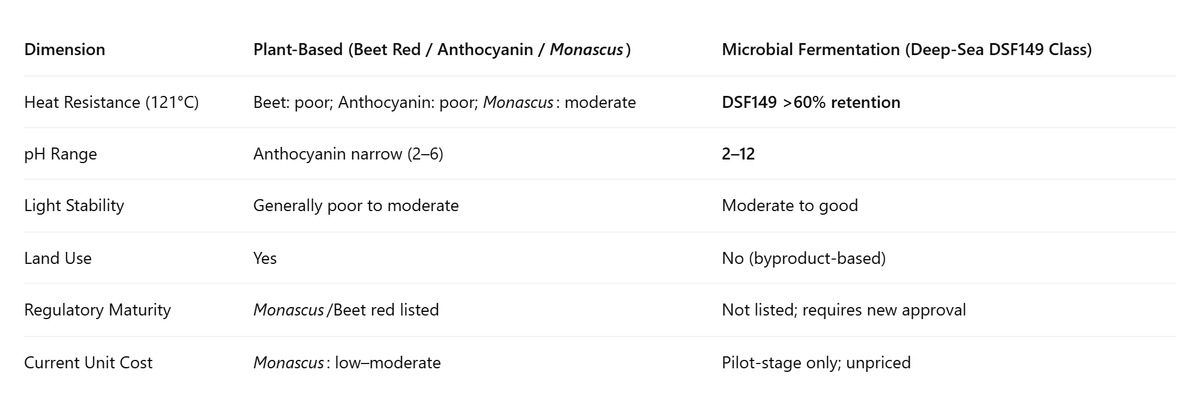
What it truly fills is the gap for "natural red that survives high-temperature sterilization + wide pH range without fading." Historically, this niche could only be covered by Monascus red (which leans orange-brown) or certain caramel colors. Deep-sea Talaromyces red offers a bluer-toned true red — a more direct substitute for carbonated drinks, jelly, and UHT milk.
⚖️Current Stage Assessment
- Status: National innovation project + published patent + deposited strain. No pilot-scale fermentation data released. No GLP toxicology. No new food ingredient/additive application submitted.
- Trackable milestones:
- Q4 2026: Whether 5–10 L fermenter data is published.
- Whether a co-branded sample emerges with a local Hainan cosmetics manufacturer.
- Whether DSF149 enters pre-submission communication for a "marine microorganism-derived natural colorant" novel additive application.
- Competitive landscape:
- Brazil's T. amestolkiae cosmetic formulation paper was published in ACS Omega (2025).
- Egypt's T. atroroseus wheat-bran strain had 121°C data available as early as 2023.
- DSF149's differentiation lies in deep-sea origin narrative + pH 2–12 stability + dual-function antimicrobial activity. It is not a fundamental mechanistic breakthrough (0→1), but rather an engineering improvement in strain selection + local substrate optimization (1→1.5).
