
I. Timeline and Origin of the Incident
- Around August 6, 2026: A series of highly similar staged videos appeared simultaneously on Weibo, Douyin (TikTok China), and Xiaohongshu (Little Red Book). In these videos, someone claiming to be a "baker" poured half a small bottle of black food coloring into white cream, producing a pitch-black, bitter cream, and claimed, "Dark-style cakes are all made by piling on coloring; your tongue and teeth will turn black after eating." The hashtag #IDontRecommendBuyingDarkCakes trended. State media outlets including CNR's News Horizon, CCTV Finance, and Jiangsu Communist Youth League subsequently reported on it.
- Video Characteristics: Multiple media outlets found that different accounts' videos had identical plots, scripts, and camera angles (same pouring motion, same tongue-staining close-up, same persuasive text). Some accounts normally had single-digit likes but suddenly got tens of thousands on this one post — a classic "anxiety-driven traffic" template.
- Consumer Feedback: Some netizens posted about "black tongues and blue/black excrement after eating dark cakes," which experts explained was caused by temporary staining from compliant colors (Brilliant Blue, Erythrosine, etc.) or psychological suggestion, not evidence of poisoning.
II. Expert & Industry List of "Real" Methods for Black Coloring
In professional baking, there are two routes for achieving black/dark brown coloration:
1. Cake Body Coloring (Primary Color Source)
- Alkalized Black Cocoa Powder (Dutch-processed black cocoa): High-temperature alkali treatment removes acidity, resulting in a deep brown-to-black color with an Oreo-like aroma. This is the most mainstream method for "black gold" cakes. It is a food ingredient, not an additive.
- Squid Ink (Cuttlefish Ink): Naturally deep black with a seafood umami flavor. Commonly used in savory items like black gold custard buns or squid ink bread. Rarely used in Western pastries due to flavor conflict.
- Vegetable Carbon Black (China GB 28308-2012, INS 153): Made by carbonizing bamboo, coconut shells, or wood chips. Odorless and tasteless. Maximum usage in pastries: 5.0 g/kg (continued under GB 2760-2024). It provides only "blackness," not flavor.
2. Frosting/Decoration Micro-Adjustment (Localized Detail)
- Industry consensus: A toothpick tip dipped in one or two drops of gel colorant is sufficient. For bright red, red dragon fruit juice can be used. The so-called "half bottle" method would result in extreme bitterness, negative gross margins, and unsellable products.
- According to the Shenyang/Anshan Baking Industry Association: For display cakes requiring "deep black and high gloss," the standard practice is alkalized cocoa powder + trace amounts of vegetable carbon black, not dumping bottles of liquid color.
Professor Fan Zhihong (China Agricultural University) concluded: If the "half bottle" operation shown online were real, it would definitely exceed the limits set by GB 2760 for frosting applications (Brilliant Blue ≤ 25 mg/kg, Erythrosine/Allura Red ≤ 50 mg/kg, Tartrazine/Sunset Yellow ≤ 100 mg/kg). However, occasional consumption of a compliant dark cake is nothing to panic about. The real concern should be high sugar, high fat content, and high-frequency consumption by children.
III. Why "Half a Bottle" Is Anti-Business Logic
- Cost: Good commercial gel colors cost around $15–20 per small bottle. A retail cake sells for maybe $20–40. Pouring half a bottle destroys any profit margin.
- Taste: Synthetic black colors are usually blends (Brilliant Blue + Erythrosine + Tartrazine). At high concentrations, they have a distinct bitter, metallic taste. Stores would destroy their own repeat business.
- Filter Mismatch: Many "matte black" photos on social media are achieved through shooting filters. Physical stores rarely take such orders anyway. The videos blame "color abuse" for what is actually "filter-induced expectations."
IV. Regulatory Status and Boundaries of Four "Natural Black" Ingredients
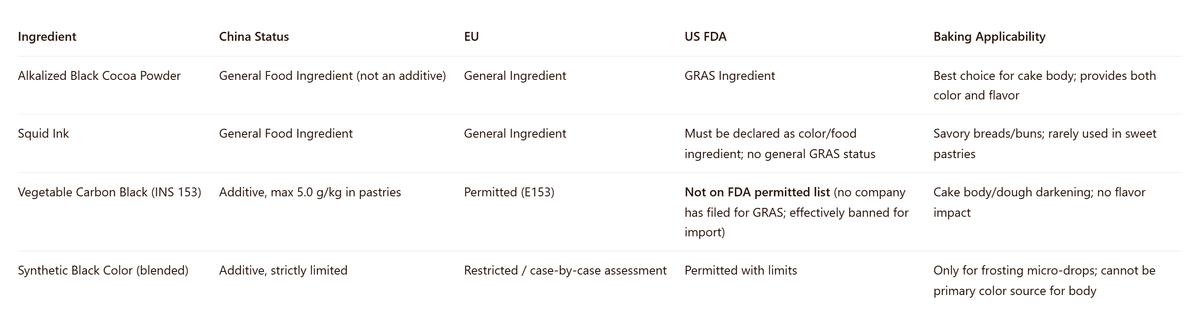
Note: In January 2026, a shipment of "Black Gold Custard Buns" from Guangzhou was detained by the US FDA. The direct cause was that vegetable carbon black has no legal status in the United States. This is a real pitfall for export-oriented bakery companies.
V. Substantive Implications for the Natural Color Industry
- "Natural Black Coloring" Has Gone from Concept to Muscle Memory for Pastry Chefs: Although triggered by staged videos, the state media's fact-checking directly fed the phrase "alkalized cocoa + vegetable carbon black + squid ink" into the public consciousness. Downstream stores will now proactively ask suppliers, "Is this naturally colored?" This forces the supply chain to shift inventory towards natural solutions for the black color segment.
- Domestic Demand for Vegetable Carbon Black Stable; Export Markets Are Split: Domestically, it remains legal and unrestricted within limits for pastries, tapioca pearls, and candies. However, for semi-finished bakery products exported to North America (e.g., black gold buns, black cookies), manufacturers must switch to caramel color or alkalized cocoa and avoid carbon black entirely.
- Window Opens for Domestic Alkalized Black Cocoa Substitution: Traditionally, black cocoa powder relies on Dutch/French alkalization processes. Chinese natural extract companies (like Chenguang, Kunyao) could leverage the "clean label black" trend to launch baking-specific powders, capturing higher margins than selling single pigments.
- "Toothpick-Tip Liquid Colors" Actually Benefit High-Concentration Natural Pigments: If natural black pigments (e.g., black carrot, black rice anthocyanins) can achieve high color value at low dosage, they perfectly fit the "a few drops for frosting" scenario, avoiding direct price competition with synthetics.
VI. One-Sentence Summary
This was not a pigment crisis, but a public opinion event driven by staged videos + filter-induced expectations + public anxiety about synthetic colors. However, it successfully pushed the "Four Natural Black Solutions (alkalized cocoa / squid ink / vegetable carbon black / fruit-juice micro-drops)" from ingredient lists into consumer vocabulary. For the natural color industry, this represents low-cost mindshare gain, not a regulatory headwind.
